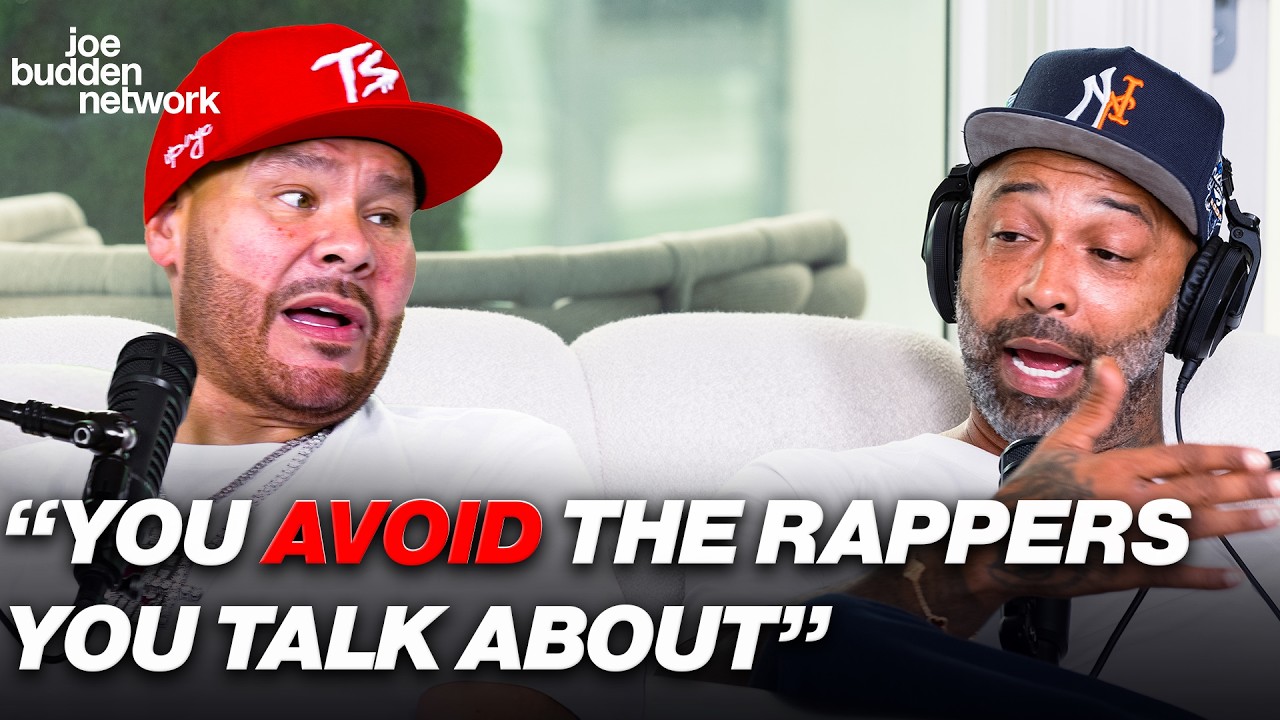
Watch the source conversation
Video: Joe Budden TV via YouTube. Embedded from the uploader’s public post; availability remains controlled by the uploader.
A Stash Spot Editorial by Doe Boy Sumz
Fat Joe is hip-hop. Let’s get that out of the way before people turn
this into an argument it does not have to be.
Joe is from the Bronx. He came up in the culture. He paid dues in the
culture. He made records that helped shape eras of the culture. He stood
beside Black artists, employed Black artists, fought for Black people
and built real relationships in Black communities. Nobody with a serious
understanding of hip-hop can erase Fat Joe from its history.
But hip-hop credentials are not the same thing as Blackness. And
loving Black people is not the same thing as having permission to use
every word Black people have tried to reclaim from their own
oppression.
That is the problem underneath the latest Fat Joe debate.
During his appearance on The Joe Budden Podcast, Joe
defended his place in hip-hop by pointing to the neighborhood that
raised him and the pioneers who were around him. He spoke about growing
up near Grandmaster Flash and Melle Mel and about his late brother
carrying records for Flash. Then the argument went further: Joe declared
himself Black and described himself, using the N-word, as the “Blackest”
one you would ever see.
The backlash was immediate. The Joe Budden Podcast later revisited
it. Marc Lamont Hill—who was not present for the Fat Joe episode—gave
his own response and drew a line that should not be hard to understand:
Fat Joe’s connection to Black people can be authentic without making him
Black. As Hill put it, “There’s no honorary degrees in
Blackness.”
That line hit because this is bigger than Fat Joe.
My Stash Spot Take
I hate using the word.
And yes, I grew up using it.
I used it in conversation. I used it in music. I used it in insults,
salutations and hellos. It could mean a friend, an enemy, a stranger or
the person standing closest to you. Context changed everything—at least
that is what we told ourselves.
But I would not say it around white people or around people from
other ethnic groups. Especially white people.
Why?
Because somewhere in my mind I always understood that this was not
just slang. I knew the word carried an old lie: a manufactured state of
superiority placed over African Americans and an equally manufactured
state of inferiority forced onto us. It was used to tell us what we were
worth, where we belonged and how little pain the world was supposed to
feel when something happened to us.
The NAACP has formally described the word as degrading and
dehumanizing and called for its eradication. That history does not
vanish because the last two letters change. “Nigga” may sound different
from “nigger” inside a familiar Black conversation, but the oppressive
system outside that conversation still knows exactly which people the
word was built to diminish.
That is what bothers me.
The more casually we use it, the easier it becomes for everybody else
to pick it up as slang. Then we look around and the whole world is
calling us “nigga.” We are still the butt of the same ugly joke; the
audience has simply gotten bigger.
People say there is a difference between the version ending in “a”
and the version ending in “er.” Really? To whom?
There can be a real difference in tone, intent and in-group usage. I
understand that because I lived it. But changing the pronunciation does
not erase the family tree of the word. It does not erase the slave
auction, the racist sign, the white mob, the segregated school, the
police baton or the grandparent who heard the hard-R version from
somebody who meant every bit of it.
We took a harsh word and made it breakfast. That does not mean it
becomes everybody else’s dessert.
“But We Grew Up Together”
New York makes this conversation complicated.
Black and Puerto Rican kids grew up on the same blocks, went to the
same schools, played in the same parks, got stopped by some of the same
cops and helped build the same culture. In the Bronx, Harlem, Brooklyn
and Queens, language traveled through hallways and across project
courtyards long before anybody on social media started debating who had
a pass.
That history is real. So is the Latino contribution to hip-hop. Fat
Joe does not need to prove his membership in the culture. His catalog
already does that.
But “Latino” is not a race. The U.S. Census treats Hispanic origin
and race as separate concepts. A Puerto Rican, Cuban, Dominican,
Colombian or Panamanian person can be Black, white, Indigenous, Asian,
mixed or identify another way. Pew Research has estimated that about six
million U.S. adults identify as Afro-Latino. Their Blackness should not
be erased inside this debate either.
That distinction matters.
Some Latinos are Black. Some are not. Some openly claim their African
ancestry. Some spend their lives running from any connection to
melanated skin. Some experience anti-Blackness directly; some benefit
from it; some can experience racial prejudice as Latino while still not
being treated as Black. None of that can be reduced to “we all grew up
together.”
Ask the ugliest version of the question.
If a racist cop pulled over an African American man and a
light-skinned, non-Black Puerto Rican man, would that cop necessarily
use the same slur for both of them? Or would his racism sort them into
two different boxes and reach for a different insult for the Puerto
Rican man?
It is an ugly example because racism is ugly. But it exposes the
weakness in the “we were all called it” defense. Were you really
targeted by this word because the system saw you as Black? Or did you
become comfortable saying it because you grew up around the people who
were targeted?
There is a difference between saying, “We have been using the
word,” and saying, “The word has been used against
us.”
Those are not the same inheritance.
The
Police Test Is Not Perfect—but the System Knows What It Sees
Race is complicated, and no traffic stop can serve as a scientific
test of identity. Dark-skinned Latinos can absolutely be racialized as
Black. Latino people also face profiling, xenophobia and slurs aimed
specifically at them. Black Latinos can face both anti-Blackness and
anti-Latino discrimination at the same time.
But that complexity cannot become a loophole that lets every person
with proximity to Black culture claim the full history of Black
oppression whenever it is culturally useful.
The system has always made distinctions when it distributes privilege
and punishment. It can celebrate Black music while devaluing Black
people. It can market our speech while penalizing our children for
speaking it. It can sell our style around the world while treating the
bodies that created it as threatening.
That is why the word is not merely a piece of hip-hop vocabulary.
Hip-hop did not invent it. Hip-hop inherited it.
And no rapper, neighborhood, friend group or podcast panel has the
authority to issue a universal license on behalf of every Black
person—living or dead.
What Would the Ancestors Say?
I keep thinking about my grandmother, who lived through the racist
South in Virginia.
Would she tell me that everybody has permission to say it now because
they know Black people? Would Maya Angelou give the okay? Would Martin
Luther King Jr.? Malcolm X? Would the ancestors who carried the wound
say the word is now a free-for-all because it became popular in rap
songs?
I do not believe they would.
They were not fighting for broader access to the slur. They were
fighting the system of thought attached to it. They were fighting for
dignity in a country that used language, law, violence, housing,
education and employment to enforce a racial order.
That is why I struggle with the audacity of people who were not
targets of the word acting as though growing up around the targets gives
them equal ownership of it.
Proximity can create family. Proximity can create solidarity.
Proximity can create shared culture. It can create a real bond worth
defending.
But proximity does not rewrite history.
This Is Not About
Calling Fat Joe a Racist
Let me be clear: I am not calling Fat Joe racist.
That would be lazy, unfair and too easy.
Joe’s love for Black people appears to be real. His place in hip-hop
is real. His Bronx story is real. The acceptance he received from many
Black friends and collaborators is real. The fact that he has heard and
used the word since childhood is probably real too.
But none of those facts requires every Black person to be comfortable
with his use of it.
One Black friend cannot issue a pass for Black America. One
neighborhood cannot sign for every generation. And “nobody around me
objected” is not the same thing as “nobody has the right to object
now.”
Hill’s response made that point without turning Fat Joe into a
villain. You can love somebody and still tell them they are wrong. You
can respect a person’s body of work and reject one part of their
argument. That is what grown cultural conversation is supposed to look
like.
Fat Joe can be family to people in hip-hop without claiming Blackness
as the price of admission. He does not need the N-word to authenticate
his Bronx story. If anything, his résumé is strong enough that he should
be the easiest person to say, “I have nothing left to prove with this
word.”
Throw the Whole “Pass” Away
I do not like that anybody wants to fight to say the word.
That is where I land.
The debate is usually framed as a courtroom case: Who is allowed? Who
gets grandfathered in? Which neighborhood counts? How dark must somebody
be? Which parent or grandparent makes the pass valid? Which Black friend
can cosign it?
Throw that whole mess out the window.
If we stop calling one another “nigga,” what terrible thing replaces
it? Boss. Neighbor. Brother. Sister. Brother-in-law. My wife’s new
husband. Anything. We have an entire language available to us.
People act as if retiring the word would erase hip-hop. Hip-hop has
survived vinyl becoming cassettes, cassettes becoming CDs, CDs becoming
streams, neighborhoods becoming brands and street corners becoming
global stages. The culture will survive a better greeting.
And yes, Black people have to confront our part too.
We cannot broadcast the word in every song, skit, caption and
conversation, then pretend we are shocked that young people around the
world imitate what they consume. Art travels. Language travels. What we
normalize will be repeated.
But imitation does not equal entitlement. Hearing a word in a record
is not consent to use it. Buying access to Black music does not mean
buying ownership of Black pain.
Black people may disagree among ourselves about reclamation. Some
will keep using the word. Some stopped years ago. Some use it only
around certain people. Some reject it completely. That internal
disagreement is itself part of the history. It is not an invitation for
outsiders to settle the question for us.
The
Question Fat Joe’s Defense Still Does Not Answer
Fat Joe has explained where he learned the word. He has explained who
used it around him. He has explained the love he has for Black people
and the role his family played near the birth of hip-hop.
All of that explains familiarity.
It does not fully explain necessity.
Why is the word so important to keep?
If Black people you claim to love are telling you it wounds them, why
is the response a résumé? Why does the right to repeat the word matter
more than the request to let it go? What is lost by choosing
respect?
That is the part I cannot get past.
I would not fight to use a slur born from somebody else’s suffering.
I would not tell that community my friends gave me a lifetime pass. I
would not argue that my zip code transferred ownership of their wound to
me.
If I loved them, I would listen.
Maybe the final answer is not that Fat Joe should stop while Black
people continue forever. Maybe the final answer is the one Marc Lamont
Hill admitted deserves serious consideration: perhaps all of us should
leave it alone.
Not because Black people failed to reclaim it. We transformed it so
completely that the world wanted to imitate us. But reclamation that
ends with everybody feeling licensed to name us by the old wound may not
be liberation.
Maybe it is just the same chain with a newer shine.
Fat Joe is hip-hop. Fat Joe can be loved. Fat Joe can be respected.
Fat Joe can be wrong about this.
And I still do not understand why anyone would want to fight so hard
to say the word.
That is my Stash Spot take.
Reader Debate / Comment
Prompt
Does growing up inside Black culture give a non-Black person
permission to use the N-word—or is the real answer that nobody should be
fighting to use it?
Sound off respectfully:
Is Fat Joe Black, culturally Black, Afro-Latino—or is that the wrong
framework entirely?
Can one group reclaim a word without eventually making it feel
public?
Does “nigga” carry a truly different meaning from the hard-R
version, or does the history remain attached?
If somebody loves Black people, should being asked to stop be
enough?
Watch the ConversationThe Joe Budden Podcast Reacts to the BacklashFat Joe’s Original Joe Budden Podcast ExchangeMarc Lamont Hill RespondsReporting and Further ReadingComplex: Fat Joe defends his place in hip-hopTheGrio: Marc Lamont Hill respondsNAACP official position on the N-wordPew Research: Afro-Latino identity in AmericaU.S. Census Bureau: Race and Hispanic originMore than headlines. We talk about what the culture means.
If this piece made you think, share it, drop your take in the comments and follow Indie Stream Media Network for more unfiltered Stash Spot editorials, hip-hop news, original films and independent culture.
Watch Indie Stream Originals and Stoop Filmyard films on Indie Stream Live TV.
Comments
Post a Comment